Why Don’t We Feel Earth’s Rotation? Physics, Seriously
Ever flopped on the couch after a day, feeling totally still? Think again, pal. Because right now, you, that couch, the trees, even those hella massive mountains – none of it is actually motionless. Not one bit. We’re on a wild ride, a dizzying cosmic dance. And the grandest magic trick of all? We truly don’t feel the Earth’s Rotation. How’s that for a mind-bender?
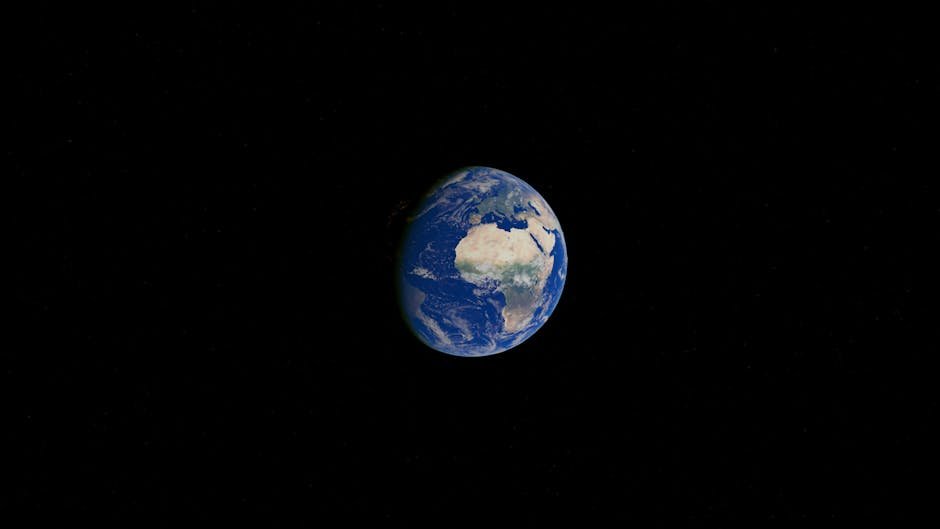
Our planet? Hyperactive beast. Always moving. She spins on her axis at the equator at a blistering 1,670 kilometers per hour. Then, she zips around the sun at 107,000 kilometers per hour. And get this: our entire solar system, with the sun at the front, orbits the center of the Milky Way galaxy. That’s a mind-boggling 828,000 kilometers per hour! You’d think all that would create some serious G-forces, right?
Why We’re Always Moving With It
Simplest answer? We’re moving with it. Everything. You, me, your dog, that coffee shop, even the air around us – perfectly connected with the Earth’s dizzying speed. There’s zero motion between us and the planet, only motion with it.
Imagine trying to chill in a car. It’s cruising at a constant speed. You can easily sip your drink. Check your phone. Just hang out. You don’t feel like you’re hurtling down the highway. Because the car, you, and the air inside? All one unit.
It’s All About Relative Motion
Feel force? Only when motion differs. Crack open that car window, stick your hand out, and boom. Air hits your palm. Why? Your hand suddenly moves at a different speed. Different from the air molecules outside the car. But close the window. Feeling gone. Air inside moves with you.
And this is key. Since everything inside the Earth’s system (you, me, the atmosphere, cities) is traveling at the same speed as the Earth itself, there’s no relative speed to make us feel the movement. We are literally one with the motion. That’s why Earth feels so chill, even zipping through the cosmos.
Still Moving, Even in Space
Think space station changes things? Nope. Even out there, far beyond the atmosphere’s edge. Still hurtling through space. Still orbiting Earth, because gravity, right? And Earth? It’s orbiting the Sun. And the Sun? Orbiting the galaxy. Phew.
We’re all part of one big dance. Yeah, your body gets tiny tidal forces. Like a small tug on your feet compared to your head. But too subtle for you to notice. But oceans? They get it. High and low tides. Visible action between Earth and Moon.
The Coriolis Effect: Earth’s Invisible Hand
Okay, so no direct spin feel. But Earth’s rotation? Hella noticeable impacts. Meet Coriolis. This bad boy, our planet’s constant twirl causes it, bends everything. Winds. Currents. Everything.
Explains hurricanes. Rarely near the equator. Big spirals near poles though. The Earth’s rotation curves their path, making them swirl. Also messes with missiles. Long flights. Makes rivers wiggle, won’t flow straight. Like throwing a ball on a spinning merry-go-round – from your seat? Ball looks like it curves.
Foucault Pendulum: The Smoking Gun
Want visible proof? Foucault pendulum. That’s your proof. This French scientist, Léon Foucault, way back when? Hung a big, heavy pendulum. High up. And it swung. Slowly shifted its path. Nothing pushed it. Crazy, right?
Not the pendulum doing it. The ground under it. Turning. Just a stunning, straightforward way to show Earth spinning. Wanna see? Build a smaller one.
Beyond Our Senses: The Power of Science
Senses are great. But limited. Built to feel motion around us. But Earth moving, huge and constant? Our insides can’t sense that.
And here science comes in! It stretches what we can ‘see’ or ‘feel.’ Helps us measure. Figure out stuff. Like Earth’s rotation, things our senses miss. Just because you don’t feel it, doesn’t mean it isn’t happening.
Harmony, Not Domination
The takeaway? We’re not just watching this planetary dance. We’re in it. Part of it. We move as one with the Earth, the solar system, and the galaxy. Trying to conquer or boss this system around? Dumb idea. Real life? Knowing our spot in this wild universe. It’s about living in harmony with the planet, not against it.
## Frequently Asked Questions
Q: Does the speed of Earth’s rotation vary?
A: Yes, slightly. Nah, not perfect. Bounces around. Tides, weather, stuff inside Earth. All change it. But these changes? Super small. Can’t feel ’em without super precise tools.
Q: Why don’t hurricanes form at the equator if the Coriolis effect is strongest there?
A: Coriolis is there at the equator. But too weak. Can’t kick off hurricane spins. Big hurricanes need strong Coriolis. Way more punch to get air spinning. That’s closer to the poles.
Q: What would happen if the Earth suddenly stopped spinning?
A: Earth stops spinning? Oh man. End of the world stuff. Everything not bolted down, not stuck into the rock – like us, buildings, things just sitting there, even the whole ocean – would keep flying eastward. Inertia, right? At Earth’s old insane speed, up to 1,670 km/h at the equator. Utter destruction. And the air? Still moving. Winds you can’t even dream of.