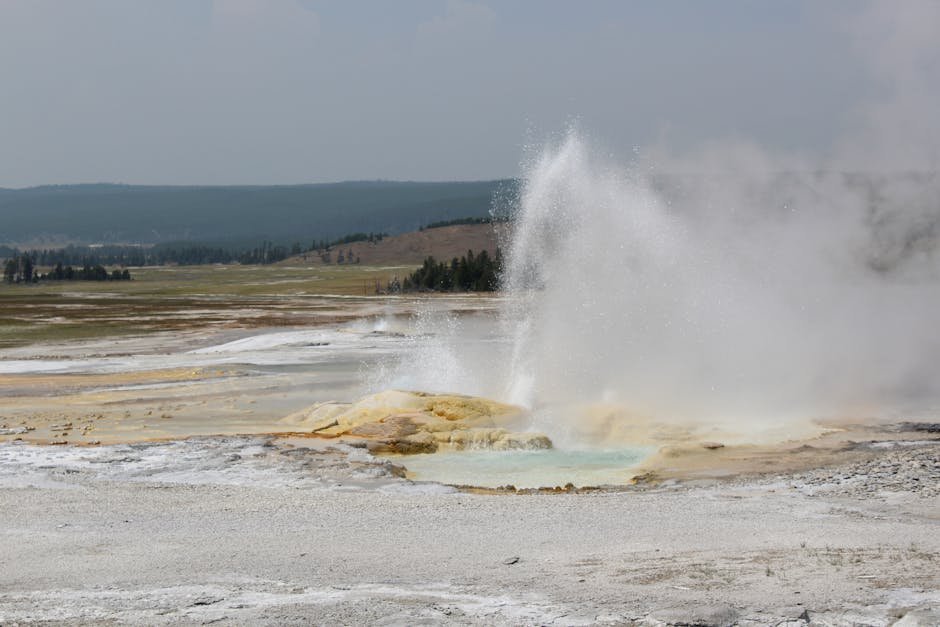
Yellowstone Supervolcano: What If It Blows?
Ever wondered what’s really under those amazing landscapes? Yellowstone National Park, for example. This place? Not just cool geysers and bison. Nope. It’s literally on top of the mother-of-all potential natural disasters: the Yellowstone Supervolcano. A sleeping giant. Certainly, but a giant able to cause some serious trouble. You see, getting a grip on this beast’s past and future isn’t just for eggheads. It’s about realizing everything we’ve built is super fragile. And that whole civilization thing? Yeah, could just be a rental.
Yellowstone’s Fiery Past: It Woke Up Before
Don’t let those pretty postcard views fool you. Because while the odds of the Yellowstone Supervolcano blowing up right now are super low, this thing? It stirred before. Three distinct times, actually. We’re talking 2.1 million years back, then 1.3 million years ago, and the really big one? That was 664,000 years ago. Geologists? They’re not saying it’ll erupt soon. Based on current info. Good news, mostly. But honestly, it’s still a beast. Thousands of times stronger than a normal volcano, just chilling below us. Yeah. That data messes with your brain.
The Geography of Really Big Trouble
Yellowstone itself? It covers a giant area, 9,000 square kilometers. Stretches right across Wyoming, Montana, and Idaho. It’s the oldest National Park on Earth, famous for deep canyons, noisy waterfalls, twisty rivers, and those classic hot springs. Folks stroll the trails. They watch the animals. And they often just forget they’re literally walking right over an absolutely enormous supervolcano caldera, easily 50 to 70 kilometers wide.
This is not some weird fluke of nature. Volcanic areas? Full of minerals. Creates super rich, fertile soil. Historically, people would totally move close to volcanoes because of this bounty. Then they faced brutal fallout. But honestly, Yellowstone’s potential for destruction is exactly why its natural beauty and diversity are so alive. Pretty odd, right? It’s just wild.
What EXACTLY is a Supervolcano?
The term “Supervolcano”? Not really a science word, you know. It bounced around in the 1940s, then actually crept into scientific talks after 2000. But make no mistake: it’s all about scale. Just huge. Terrifyingly huge.
They measure volcanic eruptions with something called the Volcanic Explosivity Index (VEI). It’s a ladder from 0 to 8. And each jump up? That’s an eruption ten times stronger. Picture the Richter scale but for lava and ash. Even a VEI 6 eruption? It’s a global incident. Krakatoa in 1883 or Pinatubo in 1993, both hit VEI 6. They shot out more than 10 cubic kilometers of stuff. Ash clouds soared further than 30 kilometers high. These babies go off maybe once a century.
And another thing: a supervolcano? That’s a VEI 8 or bigger. Straight-up “mega-destructive.” There are about 20 known supervolcanoes out there. Yellowstone? Probably the biggest deal for any future mega-blasts. If Yellowstone really let loose, it could be 50 times the power of Krakatoa. We’re talking over 1,000 cubic kilometers of debris launched way up. The ash cloud zooming 50 kilometers high. Nobody in written history has ever seen one of these blow. The last one—Taupo in New Zealand—happened 26,500 years ago. So, what would that even look like?
Instant Replay: Pyroclastic Flows, Ash Everywhere
First thing you get? Pyroclastic flows. These aren’t just dusty puffs; they’re like super-hot avalanches of gas and shattered rock. Zooming across the land at 300 km/h. Screaming fast. Back in 1902, even a VEI 4 eruption wiped out a whole village in Martinique with one of these. A supervolcano? It would let loose flows on a scale you just can’t fathom.
After that first enormous blast? Then comes the giant, world-covering ash and gas cloud. Places like Wyoming, Montana, Idaho, and Colorado? Might find themselves under over a meter of volcanic ash. Think about it. That’s an area bigger than lots of European countries. Totally buried. And you know what? You can’t just “sweep up” volcanic ash. Not really.
The Choking Cloud: Ash Kills
Forget campfire smoke or a dusty construction site. This stuff? Trillions of tiny bits of rock and glass. Breathing that in? Total death sentence. For lungs. All lungs, human and animal. Millions, maybe even billions, of living things would just die off.
And the weight of this ash? Oh boy, it’s enormous. Roofs would just cave in. Greenhouses? They’d totally implode. All our critical systems—electricity, water lines—they’d just stop. Useless. For who knows how long. So, this isn’t just a minor problem. It’s a full-on society breakdown.
The Big Freeze: Volcanic Winter & Global Chaos
The really scary part? The long term. Just think about the Toba eruption in Indonesia, 74,000 years ago. A big VEI 6 event. That thing dove the whole world into six years of volcanic winter. A warmup for a thousand-year ice age!
So, here’s the deal: volcanoes blow, right? They shoot out steam, carbon dioxide, and sulfur dioxide way into the stratosphere. That sulfur dioxide? It’s the big troublemaker. It mixes with water vapor and forms these little mirror-like bits – sulfate aerosols. These things reflect sunlight. Right back out from Earth. Less sun? Colder planet. And boom! You get what’s known as a volcanic winter. Not just feeling a bit chilly, this is prolonged, global freezing. Wrecking everything. Ecosystems. Top to bottom.
Shadows of the Past: How Big Blasts Screwed Up Humanity
The Toba event? It totally hammered human evolution. During that thousand-year global chill, the worldwide human count reportedly plunged. To maybe just 10,000 people. Seriously. It was the last big “bottleneck” our species went through. Just goes to show how fragile we really are.
And another thing: Italy’s Campi Flegrei, another supervolcano. It blew 40,000 years back. Many think that particular event played a huge part in getting rid of the Neanderthals. So, these aren’t just some neat rock facts. They’re whole population-wiping-out kind of events.
The Crazy Odds: Why We Still Have To Talk About It
A supervolcano eruption, especially if it’s Yellowstone? Low probability. Totally. But its potential impact? Off-the-charts bad. Picture years of global winter. Widespread starvation. An energy crisis. And power grids just dead forever. An internet blackout? Oh yeah. That too.
We actually got a tiny feel for this with the VEI 5 Hunga Tonga eruption in the South Pacific just back in 2022. Even that medium-to-strong event cut off talking for days. It shattered undersea cables. Sent tsunamis across oceans. Contaminated water and food for hundreds of kilometers. Just breathing was tough.
But even knowing about these possibilities, however super remote, forces us to really think. It hammers home how truly, deeply vulnerable we are on this giant rock we call home. We build our civilizations. We cook up these illusions that things will last. Often just letting our destructive side win. But knowing our whole existence is as shaky as the next supervolcano or asteroid hitting us? Maybe that kind of sharp clarity helps us truly value what we’ve got. And each other. Hope you’re all keeping safe out there.
Got Questions? We Got Answers
How many times did the Yellowstone Supervolcano erupt before?
The Yellowstone Supervolcano has had three huge eruptions in its long history: 2.1 million years ago, 1.3 million years ago, and that last big one, 664,000 years ago.
What’s a pyroclastic flow and how fast does it go?
Pyroclastic flows are these thick, super-fast clouds made of crazy-hot gas and pieces of volcano. They can rip across the land at up to 300 kilometers per hour. Think a really intense avalanche.
What makes a “volcanic winter” happen after a supervolcano explodes?
A volcanic winter starts when sulfur dioxide—that gas shot into the stratosphere during the eruption—creates sulfate aerosols. These tiny particles? They bounce sunlight away from Earth. Which means long-lasting cold and global chilling temperatures.