The Lowdown on Mars: Exploration, Surprises, and the Wild Hunt for Life
Ever stared up at that blood-red light in our night sky and thought, “What is going on up there?” Because the story of Mars Exploration? It’s bonkers. From folks squinting through old telescopes to today’s rock-crawling robots, it’s a cosmic adventure, packed with unexpected twists. Forget what you think you know about our planetary neighbor. The real tale is way more complicated.
Back in the Day: Looking Through Lenses and Dreaming Big About Martians
So, when Galileo first peeked at Mars through his telescope? Barely any surface details. Just specks. But that sure didn’t stop people’s brains from going wild. Fast forward to the 1700s, and astronomers like Christiaan Huygens started making out faint dark spots. Oceans, maybe? He even figured out Mars’s day, or “sol,” was a cool 24 hours and 37 minutes. Pretty Earth-like, right?
By the 1800s, with better gear, astronomers were mapping polar ice caps, clouds, and atmospheric stuff. And some, well, they famously “saw” what looked like rivers. Or canals. This sparked a huge wave of imagination: canals had to mean canal-builders. People. Smart folks. Full-blown civilizations, even. That became the hottest theory.
And this wasn’t just for the science crowd. It seeped right into regular culture, sparking both fascination and some serious fear. H.G. Wells’s War of the Worlds? Perfect example. Terrifying Martians eyeballing our blue marble. Loads of people were genuinely scared, until — like always — science stepped in. By 1909, Eugène Michel Antoniadi, a Greek astronomer, figured out those “canals” were just optical illusions. A simple trick of the eye. Spacecraft, a lot later, confirmed the blunt truth.
Then Came the Robots: Mariner and Viking Showed Us a Cold, Dry Mars (But With Water Clues!)
Getting to Mars? Not easy. Seriously tough. Over half of the early tries just flat-out failed. Why? Because the best launch window only pops up every two years. Miss it, and you waited. So, scientists learned to send missions in pairs. Just in case.
In ’65, the Mariner 4 flyby gave us an up-close look. What did it find? A heavily cratered, ancient surface. These craters, 3.8 billion years old, were super preserved. All thanks to Mars’s thin air and zero tectonic plates to smooth things over.
Then Mariner 9 arrived in ’71. First spacecraft to actually orbit Mars. And it showed up to a shocker: a planet-wide dust storm! So huge it hid the entire surface for two months straight. Once it cleared, though, Mariner 9 revealed recent volcanoes. Like the enormous Olympus Mons.
The Viking mission in 1975? Total game-changer. They actually put two landers on the Martian surface. These robots hunted directly for life. The initial results? Kinda a bummer. No evidence of life as we know it. But they weren’t totally empty-handed. Their geology observations gave rock-solid proof. Proof of massive amounts of liquid water in Mars’s past. Huge river valleys. Stuff that yells “ancient lakes!” Chemical tests? Absolutely backed this up, pointing to a time, the Noachian Age, when water just streamed everywhere.
That Red Color? It’s Rust
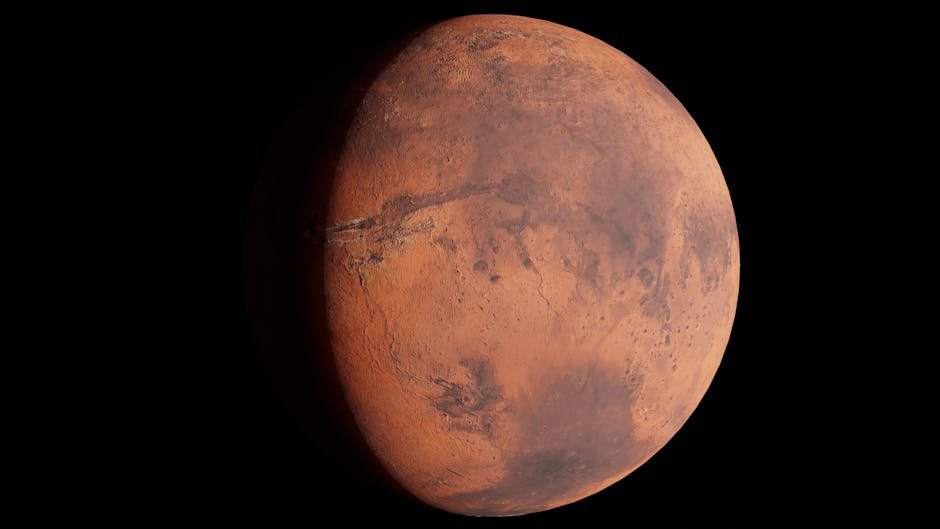
That famous red hue? Not just for looks, you know. The Martian ground is covered in fine reddish dust. That’s iron oxide. Rust. And where does rust come from? Iron mixing with water. So this distinct color? A massive sign of a wetter, more Earth-like planet, long ago.
Mars Lost Its Shield: No Magnetic Field Means Big Trouble
And here’s the kicker for any potential life up there: Mars’s “heart” stopped beating. Its core, which was once hot and sloshing around like Earth’s, cooled down. Solidified. Billions of years ago.
No working core means no protective global magnetic field. Big problem. Because without that magnetic field, Mars just sits there, completely exposed to crazy cosmic radiation from the sun and deep space. Anything on the surface, or even just beneath it, gets hit constant. Like standing in a bullet storm with no shield. And this also explains why Mars’s old, thicker atmosphere just eroded away. Leaving it thin. Not able to hold liquid water on the surface for very long now.
The Hunt Continues: Curiosity and Perseverance Are Still Looking
But, despite all this, we haven’t given up. No way. The science folks are super focused on understanding if the planet could still host life. Even just tiny microbes. Today, like, four to eight autonomous vehicles and rovers are always active up there. Drilling. Testing. Sending back data.
Since 2010, rovers like Curiosity and Perseverance keep exploring. Confirming even more signs of past water. And analyzing the Martian soil’s tricky chemistry. The hope? That deep down, or in some protected spot, some kind of life – tough and weird – could still be found.
Nasty Dust Storms: A Real Pain for Our Robots
Remember Mariner 9 getting blinded? Not a one-off. Mars is seriously known for its dust storms. These can be anything. Small, local whirlwinds. Or giant, planet-covering events that go on for months. And another thing: such storms cause major headaches for our tech. In 2018, the Opportunity rover, a total champ, just went silent. Its solar panels were completely caked in dust from one of these monster storms. Power gone. Just like that.
Olympus Mons: The King of All Volcanoes
One of the coolest finds on Mars is Olympus Mons. This massive shield volcano, finally seen clearly after Mariner 9’s dust storm drama, stands an incredible 24 kilometers (that’s nearly 15 miles!) high. Three times taller than freaking Mount Everest! Its sheer size perfectly shows Mars’s unique geological past. And its lower gravity.
So, what’s next for Mars Exploration? The red planet still holds so many secrets. Just waiting for the next generation of brave explorers to figure them out.
Quick Hits on Mars
Q: Because why is Mars red?
A: Mars is red because of iron oxide. Basically, rust. That’s in its soil and dust. The iron mixed with water way back, making it all rusty-looking.
Q: How long’s a day on Mars?
A: A Martian day, called a “sol,” is about 24 hours and 37 minutes. Pretty close to Earth’s day.
Q: But why no strong magnetic field for Mars?
A: Mars doesn’t have a strong global magnetic field because its core cooled down and solidified eons ago. Unlike Earth’s constantly moving, molten middle, Mars’s inactive core just can’t make that protective field.