Dark Photons: What’s the Deal with Dark Matter, and Is There a Secret Force?
What if everything we know about the universe is just… a tiny slice of the pie? Totally forget what you thought you knew about the cosmos. For decades, physicists have wrestled with the biggest mystery out there: dark matter. It’s the invisible glue. Holding galaxies together. A dominant force we simply can’t see, touch, or even measure directly. But what if this cosmic puzzle isn’t just dark, but has its own kind of “light”? And another thing: what if a “fifth force” is out there, carried by sneaky dark photons?
Dark Matter: The Universe’s Hidden Anchor
Picture a giant ball of water, perfectly round, just floating in deep space. Logically? That water should spill. It should flow and scatter everywhere. But it doesn’t. You’d instantly assume there’s some invisible clear container holding it all together, right? A glass sphere. Invisible.
Well, that’s exactly how scientists are looking at galaxies. The visible matter in galaxies – all the stars and gassy stuff we can see – just isn’t weighty enough to hold them together. Especially at the edges. Everything should be flying apart. Or maybe spinning way slower. Yet, galaxies spin surprisingly fast. And they don’t lose their shape. Crazy.
That invisible container? It’s what we call dark matter. Physicists believe it just kinda hangs out in galaxies and galaxy clusters, pulling things with a powerful gravitational force without touching light. Not soaking it up. Not bouncing it back. Never scattering it. For actual light, dark matter is truly unwelcome. It makes up a mind-blowing 80% of the universe’s mass.
The Standard Model’s Missing 80% Problem
Our current big rulebook for the universe, the Standard Model of particle physics, does an amazing job – explaining almost everything we do see. The strong nuclear force clamps atomic gunk together. The weak nuclear force manages radioactive decay. The electromagnetic force cranks out all light and chemistry. And gravity, the weakest but furthest-reaching, keeps our feet stuck to the ground. Keeps planets where they should be.
These four forces paint a vivid picture of the really tiny stuff and the really huge stuff. Everything you’re doing right now? Because of these four forces.
But when we zoom out to the wild scales of galaxies and beyond, that crisp picture? It gets blurry. Our best rules only cover about 20% of the universe’s mass. A giant 80% sticks around as a massive mystery—dark matter. This huge hole means our understanding of the universe? Still seriously incomplete.
New Kid on the Block: The Fifth Force and Dark Photons
So, what’s up with this missing 80%? Scientists aren’t just chilling out. They’re poking around with wild, but logical, ideas. One of the coolest? The chance of a brand-new, fifth fundamental force of nature. And if such a force exists, it’d need a particle to carry it. Hello, dark photon.
Think of photons as the little delivery guys for the electromagnetic force, which makes light happen. Dark photons, in this new theory, would be their sneaky, maybe heavier, relatives. Like light’s shady cousin. These dark photons could connect the visible and the invisible, chatting with dark matter and, super rarely, with our regular matter.
This idea suggests that dark matter could scatter these kinda heavy dark photons. While they might not travel far, sometimes, these dark photons could mess with regular photons. A tiny energy shift. A small change in path. These are the whispers. From the dark side.
The Hunt: Experiments at CERN
Finding something that rarely talks to us? Hella tough. You can’t just see a dark photon. Instead, scientists hunt for clues. If dark photons steal energy or change the direction of normal photons, those barely-there changes could be big giveaways.
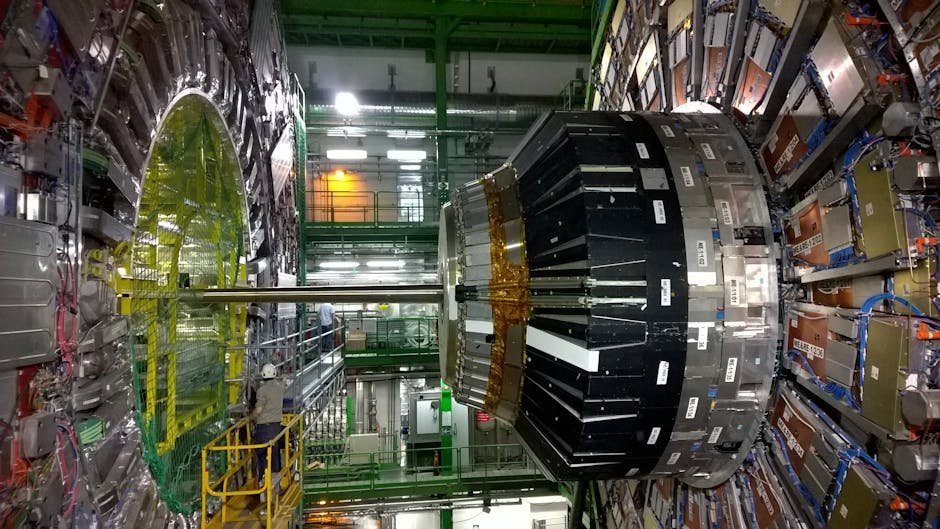
This is where epic machines like the Super Proton Synchrotron (SPS) at CERN come in. It’s huge. Researchers spent three years sifting through data from countless proton smash-ups. Billions of high-energy electrons showed up. And when electrons hit with such force, they spray out tons of photons.
The team specifically checked out those photons. Their mission: find weird stuff. Any little hint that something unseen had swiped a bit of energy, or nudged a photon off course. Any sign that dark photons had made a fleeting appearance.
The result? The photons behaved exactly as expected. No energy got stolen. Their directions were normal. No dark photons showed up here. Bummer.
Forget WIMPs and Axions (for a sec): The Search Goes ON
Did this mean dark photons don’t exist? Nah. That’s not how science rolls. Not finding something in one specific test isn’t proof it’s not there. It just means this specific method, from this particular angle, didn’t spot them.
Scientists are nowhere near quitting. The hunt for dark matter and its potential messengers involves a bunch of different ideas. Besides dark photons, there are theories like Weakly Interacting Massive Particles (WIMPs), or dark matter interacting only via gravity, which makes it super hard to ever find directly.
The grand thing about discovery is often just changing how you look at stuff. Because sometimes, you’re searching for ages for something that’s right in your face. All it takes is a different view, a fresh game plan. Suddenly, boom. There it is. The quest for dark photons and the real deal about dark matter rolls on with new experiments and different ways to look. Someone, somewhere, is still looking. And one day, that hidden secret just might pop out into the light.
Frequently Asked Questions
What exactly are dark photons?
Dark photons are these theoretical particles. Made-up, but maybe real. They could carry a “fifth force,” managing connections only within dark matter and, every now and then, subtly messing with regular matter through photons. They’re like an invisible twin to the light-carrying photons we know.
Why do scientists think dark matter exists if we can’t see it?
Scientists kinda figure dark matter exists mostly because of its big-time gravitational effects. Galaxies and clusters of galaxies act as if there’s way more mass than we can see. Without dark matter, everything would just fall apart.
Have dark photons been detected?
Not yet. Lots of tests, including those at CERN’s Super Proton Synchrotron, have looked for clues of dark photons by checking for weird stuff in how normal photons act. So far, photons have done what they always do, without any sign of dark photon interaction. But the search continues with fresh smart thinking.